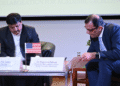
Shri Mansukh Mandaviya and other Union ministers used the Times Network platform to explain reforms, air quality measures and governance priorities.
Labour reforms, environmental challenges, and questions of governance dominated discussions at the 11th edition of the India Economic Conclave in New Delhi, as senior Union ministers laid out the government’s positions on some of the most debated policy issues facing the country. Organised by Times Network, the conclave brought together policymakers, industry leaders, and economists to examine India’s economic and institutional priorities.
Speaking at the conclave, Mansukh Mandaviya, Union Minister for Labour and Employment, Youth Affairs and Sports, explained the rationale behind replacing 26 pre-Independence labour laws with four consolidated labour codes. He said the reforms were aimed at creating a modern legal structure that supports both workers and industry, with the labour force identified as a central pillar of India’s economic journey as the country approaches 100 years of Independence in 2047.
Mandaviya noted that more than 40 crore workers are engaged in manual labour, wage work, and nation-building activities, and said successive governments had failed to significantly improve labour welfare or create conditions that allowed industries to expand at scale. According to him, employment generation and industrial growth are interlinked, and policy must recognise that workers and industries depend on each other to function effectively.
Referring to the passage of the labour codes between 2019 and 2020, Mandaviya said the government followed a development-focused approach anchored in reform and performance. He acknowledged that implementation did not begin immediately and that the reforms faced criticism and resistance from sections of trade unions. He added that extensive consultations were held to address concerns, following which several state governments amended their local laws to align with the new codes. The Prime Minister, he said, had emphasised the need for uniform implementation to ensure a common legal framework across the country.
Highlighting specific provisions, Mandaviya said the labour codes include safeguards for workers’ rights, including equal wages for men and women and the assurance of minimum wages nationwide. He described wage parity as a fundamental right for women and said the reforms were intended to create a fair and contemporary labour system suited to India’s evolving economy.
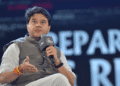
The conclave also featured remarks from Jyotiraditya Scindia, Union Minister for Communications and Development of the North Eastern Region. Scindia said India is at a decisive point in its economic trajectory and pushed back against claims that manufacturing in the country is in decline. Referring to comments made by Congress leader Rahul Gandhi during a visit abroad, Scindia said such narratives overlook India’s growth story and achievements in recent years.
Scindia argued that citizens should take pride in the country’s progress and said India’s manufacturing and economic development must be viewed in a broader context. He added that as India positions itself as a global hub for talent and innovation, it must also address challenges that affect quality of life, particularly environmental issues.
On air pollution, Scindia called for scientific and long-term solutions rather than short-term measures. Referring to the recurring winter spike in Air Quality Index levels, especially in the Delhi-NCR region, he described air pollution as a serious public health concern that cannot be postponed. He cautioned against expecting quick fixes, noting that the problem stems from layered and long-standing causes that require sustained intervention.
Parliamentary affairs were addressed by Kiren Rijiju, who responded to questions regarding Opposition conduct during parliamentary sessions. Rijiju rejected comparisons between Rahul Gandhi’s absence from Parliament and the Prime Minister’s official overseas visits, stating that the two were not comparable as one involved national duty and the other personal engagements.
Rijiju also spoke on the issue of pollution debates in Parliament, urging members across parties to participate constructively in discussions. He said that when pollution was listed for debate, disruptions prevented meaningful dialogue, despite the issue affecting citizens across political lines.
Environmental concerns were further addressed by Bhupender Yadav, Union Minister for Environment, Forest and Climate Change. Responding to questions on inter-state coordination and pollution control as GRAP Stage 4 measures remained in force, Yadav said earlier administrations had failed to act decisively when opportunities existed. He noted that meteorological factors such as Western Disturbances complicate the issue during winter months.
Yadav said the government is implementing multiple measures based on studies of global practices, including approaches taken in countries such as China and the United Kingdom. He added that while results would take time to become visible, coordinated action across stakeholders was underway and early signs of improvement would emerge over the coming years.
Beyond policy discussions, the conclave featured industry perspectives from leaders across sectors. Tarun Garg, Whole Time Director and Chief Operating Officer at Hyundai Motor India, reflected on the company’s three-decade journey in India, including design choices behind models such as the Santro and the growth of the Creta SUV. He also spoke about the company’s export strategy and recent public listing.
Automotive trends were also discussed by Partho Banerjee, Senior Executive Officer for Marketing and Sales at Maruti Suzuki India Limited, who addressed electric vehicle adoption. He said EV penetration remains limited and emphasised the company’s focus on addressing concerns of its existing customer base rather than targeting early adopters alone.
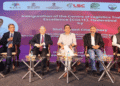
The conclave featured a broad range of speakers, including economists, policymakers, and industry executives, covering themes such as geoeconomics, technology, financial markets, space economy, renewable energy, and public policy. The sessions reinforced the conclave’s role as a platform for dialogue between government and industry at a time of rapid global change.
The 11th India Economic Conclave concluded with a renewed focus on aligning policy, industry, and institutional reform to support India’s long-term growth ambitions, as the country navigates economic transformation alongside social and environmental challenges.
At Prittle PrattleNews, featuring you virtuously, we celebrate the commitment and innovation. Led by Editor-in-Chief Smruti Bhalerao, our platform is dedicated to sharing impactful stories that inspire change and create awareness. Follow us on LinkedIn, Instagram, and YouTube for more stories that matter.











































































1 Comment