




THE IDEA IN THREE LINES
AN AI PROPOSES A STEP.
THE 0→1 DOCTRINE CHECKS IT PRE-EXECUTION, AGAINST LIMITS HUMANS SET.
BBAT SORTS ROT DATA AND OLD STRANDED ARCHIVES, EACH DECISION SEALED WITH A RECEIPT.
How was an AI discovery reached? Inventor Vatsal Soin’s 0→1 Doctrine and Band-Based Archive Triage (BBAT) are designed to check each step of AI discovery before it runs and keep a record others can verify
At its core, the 0→1 Doctrine is a common language: any need or limit becomes a number between 0 and 1, where 0 means no fit and 1 the edge of ideal fit, so an AI’s step can be tested pre-execution against limits humans set and sealed in a receipt. Band-Based Archive Triage (BBAT) uses the same scale on the labels of archived data, to sort it without opening it. These two Metainventions work alone; together, one scale reads both the action and the data behind it. This piece looks at AI discovery.
A DISCOVERY NEEDS A TRAIL
AI-made results now appear in mathematics, physics, biology and computer science, and reviewers are asking how each one can be checked. A result is as trusted as the trail behind it. Others will ask what the AI was allowed to do, what it did and which data it used. Today those answers often sit apart, if kept at all.
WHAT WAS THE AI ALLOWED TO DO?
The 0→1 Doctrine is designed to turn each limit that matters, such as safety, legal limits, environment and readiness, into a band between 0 and 1, using each field’s own range. A step is compared with those ranges before it runs, so what was allowed has a recorded answer.
ONE RECEIPT FOR EACH DECISION
Each governed step is designed to end with a sealed receipt, the Actuation Compliance Receipt (ACR). A receipt is a record of one decision, designed to show if anyone changed it. This one records what was compared and what followed: go ahead, adjust or stop.
WHILE THE RUN CHANGES
Real experiments rarely go as planned. The Orchestration and Compliance Token (OCT) is designed to watch a task while it runs. It can pause, reroute, reassign or pass the matter to a person when a limit is near, and each change is designed to be recorded.
WHEN A HUMAN IS NEEDED
Some calls belong to people. The Doctrine can run with a human in the loop, where sign-off is required, or on the loop, where a human watches and steps in. A person asked to decide may be shown banded advisories, not raw data, so the decision comes with context.
IF A FLAW SHOWS UP LATER
Sometimes a mistake is found after a result is shared. The Doctrine describes a Post-ACR Remediation Chain, designed to bind a correction to the original receipt. A reader can then follow the fix back to what was first recorded, instead of finding two versions with nothing to connect them.
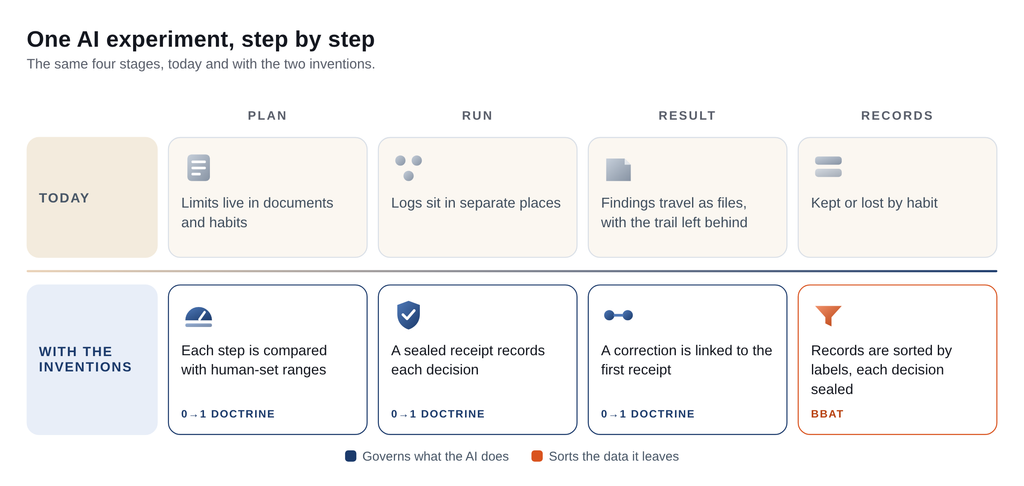
Figure 1. One AI experiment, today and with the two inventions, step by step.
THE DATA BEHIND THE RESULT
A discovery also rests on data: lab notes, instrument logs, failed runs and older papers, new today and old tomorrow. Much of it becomes ROT data (redundant, obsolete, trivial) or sits in old stranded archives. BBAT is designed to sort such records by labels alone, such as age, category, purpose and legal hold, without opening them. Each record can be kept, promoted for use or purged.
A RECEIPT FOR EACH SORTING DECISION
BBAT is designed to issue sealed receipts for its decisions, including purges, and a Human Override Pathway lets a reviewer settle a doubtful case. The record of what was kept, promoted or purged then sits beside the record of what the AI did.
CHECKING WITHOUT SEEING
According to the filing, an authorised auditor can verify BBAT receipts without seeing the content. Where records are worth sharing, BBAT is designed to reduce a group of them to one band, a bounded range that stands for the whole group, inside a secure hardware environment.
ONE EXAMPLE: A NEW MATERIAL
Example, illustrative only: an AI proposes a new battery material and reports a promising result. A reviewer asks which ranges applied, what ran, what changed and which records fed it. The receipts answer each question in turn. Where a record was purged, its receipt says so, and the content stays unopened.
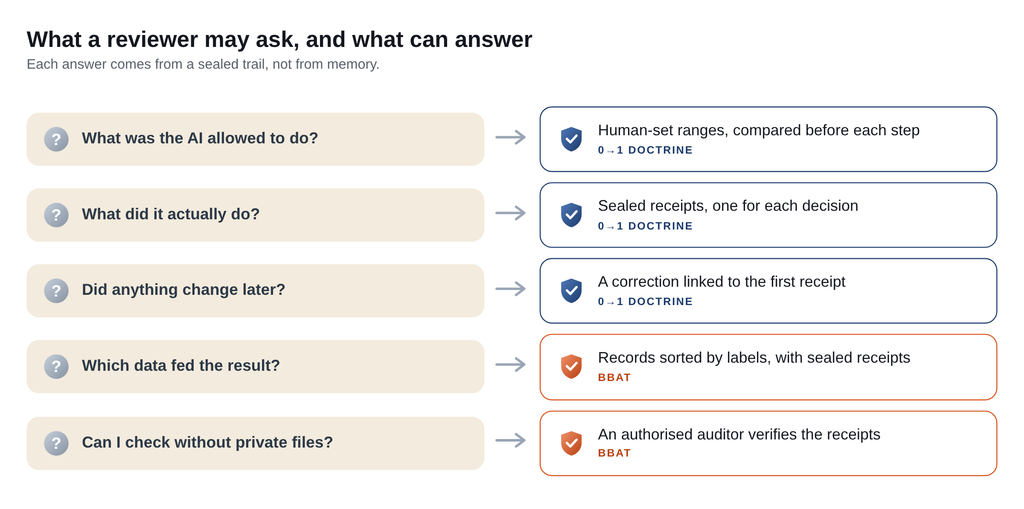
Figure 2. Five questions a reviewer may ask, and what can answer each.
EACH INVENTION ALONE, OR BOTH
The Doctrine works without BBAT, and BBAT works without the Doctrine. A team that runs experiments may begin with receipts for actions. A team with large archives may begin with sorting. Used together, the action trail and the data trail can be read side by side.
BEYOND ONE LAB
Receipts and bands are designed to travel where raw data should not, so a partner or reviewer can check a claim without receiving private files. As more AI joins research teams, a shared way to show what happened may matter as much as the discovery itself.
TOWARD A SUPERINTELLIGENT FUTURE
Superintelligence does not exist today, and nothing here claims to bring it closer. If it arrives, and as AI scientists multiply before it, the need to show how each step was handled will probably grow. Both inventions are designed to give humans ranges set beforehand and a sealed trail afterwards.
WHAT TO KEEP IN MIND
These are design aims from the filings, not results from deployments. A receipt shows what was checked and recorded; it does not prove that a result is true, and the value of a range depends on the humans who set it. Each invention is designed to support existing review, not replace it.
QUESTIONS ON READERS’ MINDS
Can small labs take part?
The Doctrine’s filing describes offline modes with paper, QR codes and text messages, so places with weak connections may still take part.
Does it fit the tools a lab already uses?
The Doctrine is designed to connect to existing software through adapters, so a lab can add it beside what it already runs.
Where does it run?
The Doctrine is designed to run in software, firmware or hardware, including on a device. BBAT’s secure step uses an isolated hardware environment.
Which fields could use it?
Any field where limits can be measured and records kept, from materials and chemistry to medicine and climate.
CLOSING NOTE
Every great discovery will face one question: who checked the steps? The labs trusted most may be those whose AI left a sealed trail. This can be tested, live, via API, governed against ungoverned, side by side.
THE INVENTOR
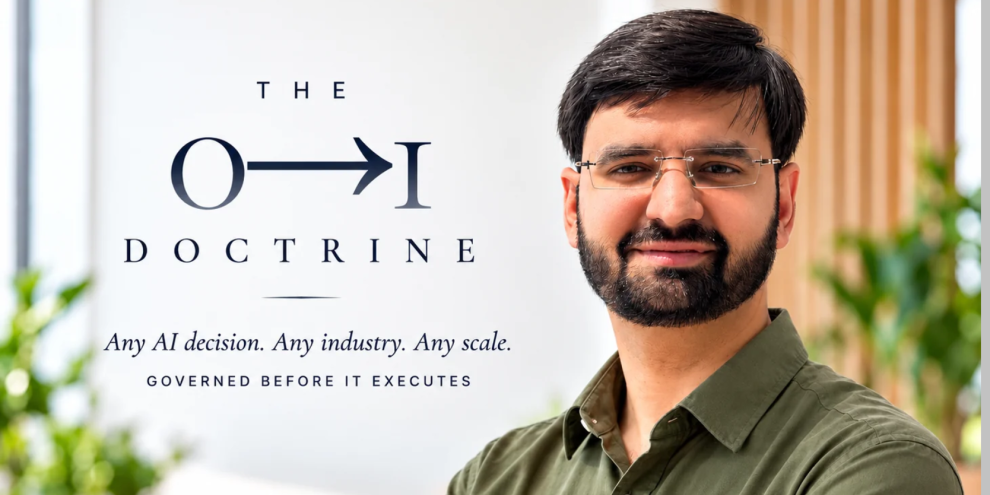
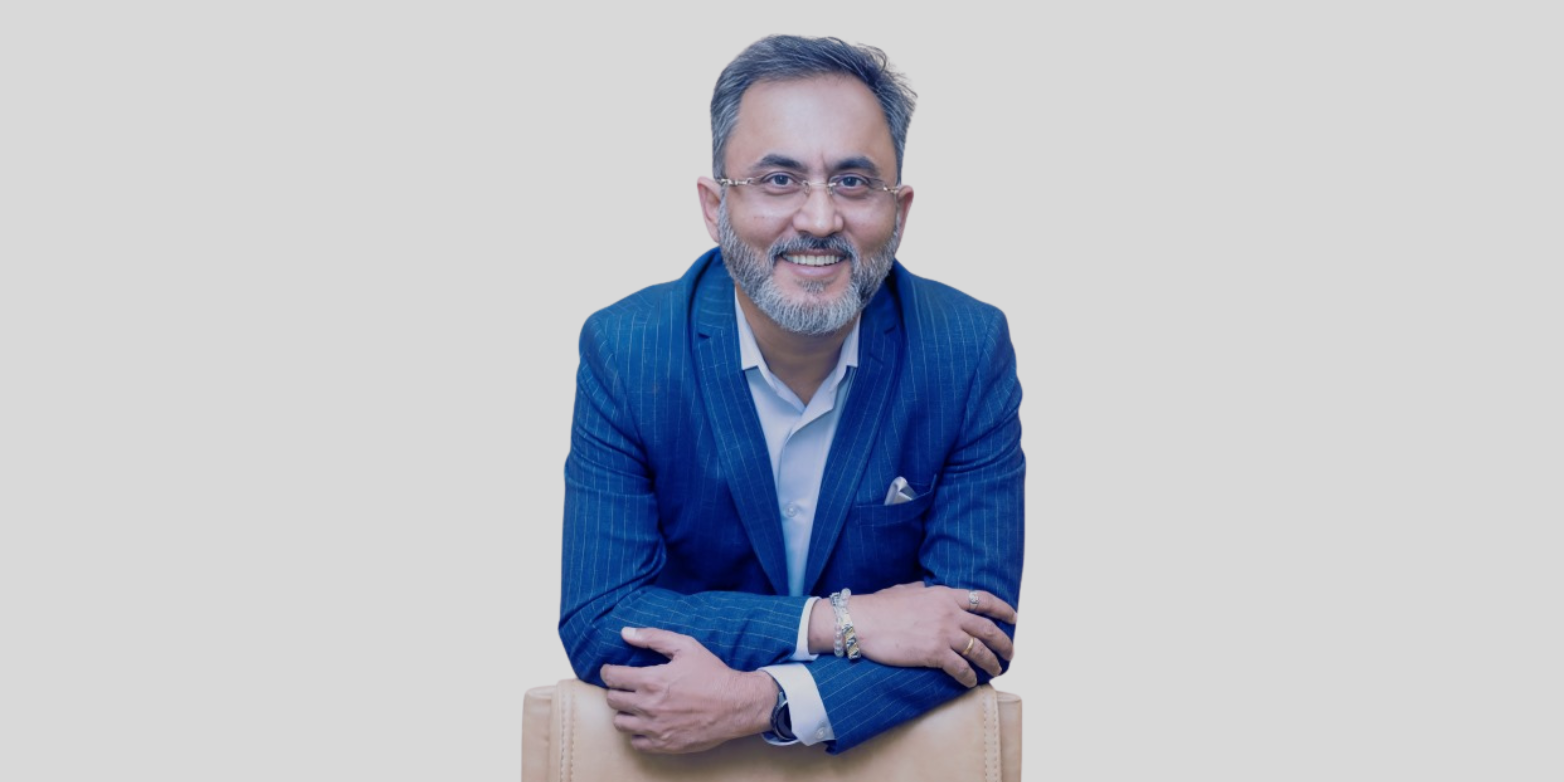
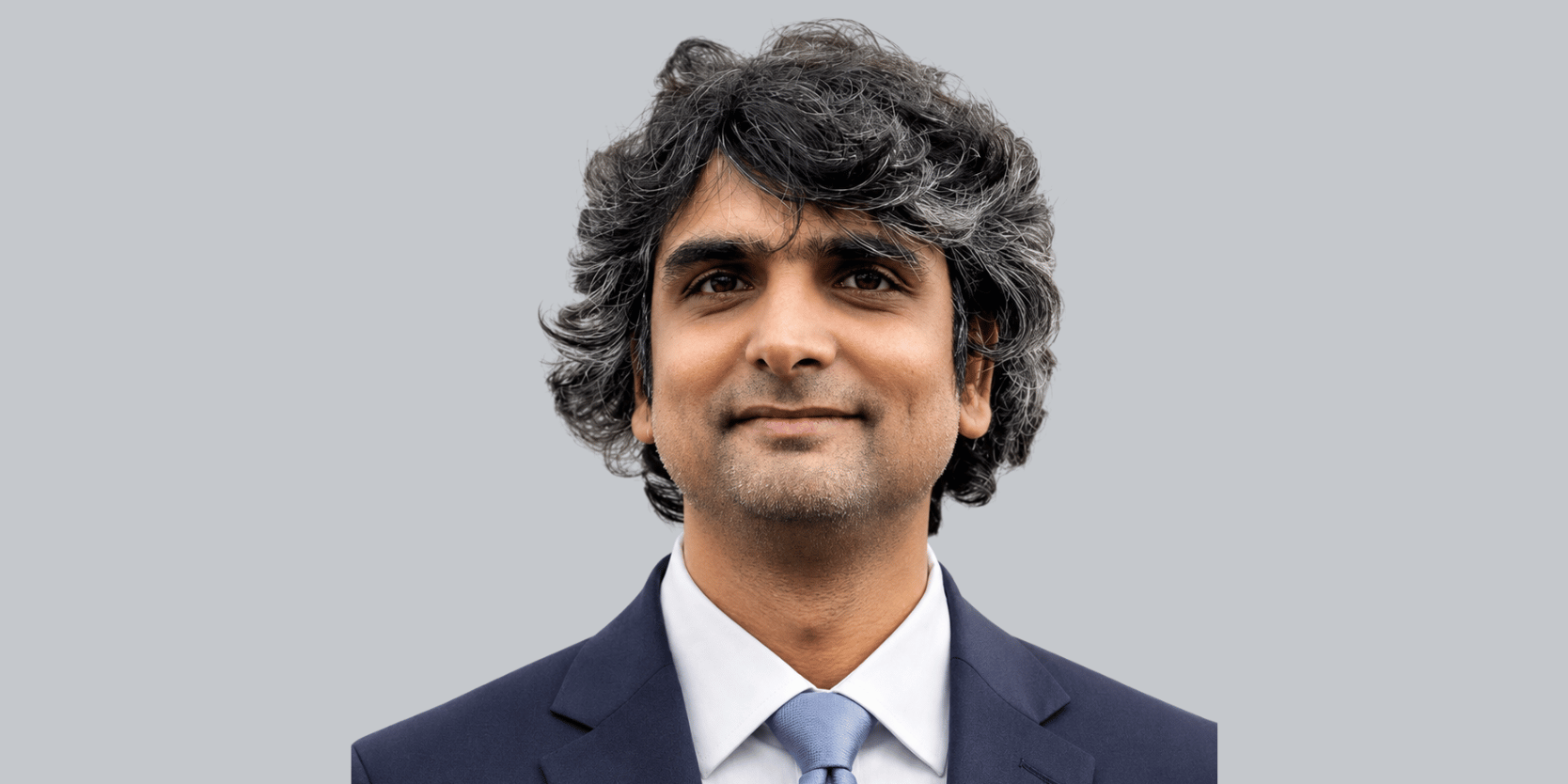
Systems theorist, inventor, and serial entrepreneur Vatsal Soin holds grants in the US, Japan, India and more; filings span six continents; latest grant, AI footwear, August 2026. Inventions: footwear, apparel fit, Sharable Size Cards, digital twins, robotics, global governed data, archive triage, quantum-resilient cryptography, AI governance. SIM–RMIT and NTU alumnus. Every prior invention was a step; 0→1 is the destination.
SELECTED REFERENCES
Granted: US Patent 12,446,652 B2 · Japan Patent 7560909 · India Patents 454081 and 599317. Filed: PCT/IN2025/051943 · US 19/489,595 · India 202511115781 · Australia AU2022450649 · India 202611113867 (23 September 2026) · PCT/IN2026/052042 (1 October 2026).
DISCLAIMER
Informational only. Not certified. No endorsement implied. Not investment advice. Examples are illustrative, not field results.
At Prittle Prattle News, featuring you virtuously, we celebrate the commitment and innovation. Led by Editor-in-Chief Smruti Bhalerao, our platform is dedicated to sharing impactful stories that inspire change and create awareness. Follow us on LinkedIn, Instagram, and YouTube for more stories that matter.
About Prittle Prattle News
Prittle Prattle News is a digital news publication covering business, technology, healthcare, education, lifestyle, public affairs and other developments from India and around the world. Led by Editor-in-Chief Smruti Bhalerao, we publish timely news, industry updates and feature stories for a broad readership.












Add Comment