
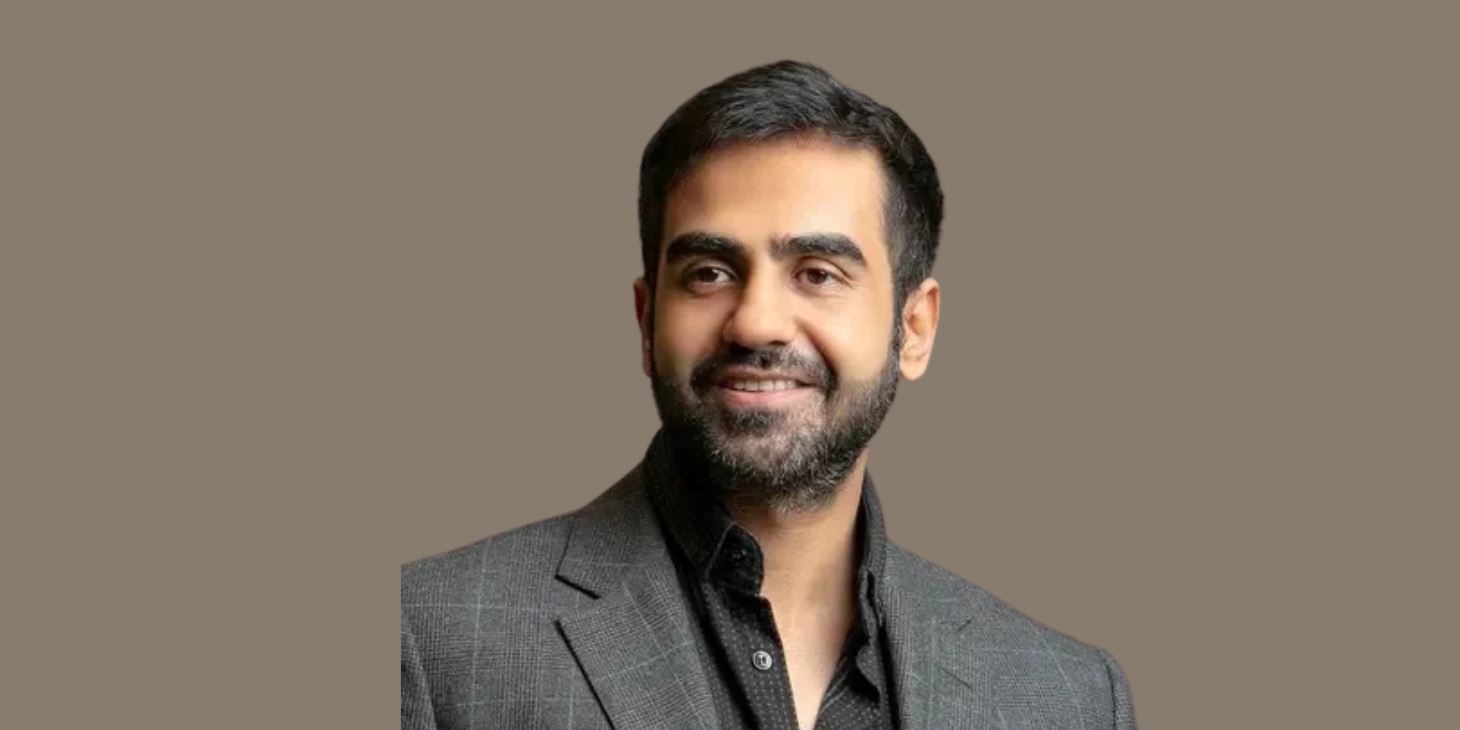








Zerodha Co Founder Nikhil Kamath has identified content creation as a potential starting point for building a business with limited capital and no professional network. He also discussed how audience reach, consumer understanding and differentiation could become increasingly important as artificial intelligence and manufacturing become more accessible.
Nikhil Kamath, Co Founder of Zerodha, explains why content creation could be a practical starting point with Rs 10 lakh and no professional contacts, as accessible technology and manufacturing change how businesses compete.
Nikhil Kamath Identifies Content Creation and Audience Reach as Key Business Opportunities in an AI Driven Economy
Nikhil Kamath, Co Founder of Zerodha, has shared his perspective on how content creation and audience distribution could influence business opportunities as artificial intelligence and manufacturing technologies become more widely accessible.
Speaking during a discussion on India’s emerging economy, Kamath addressed a hypothetical situation in which he had to rebuild his professional life with Rs 10 lakh and no existing contacts.
Rather than identifying a conventional business or investment opportunity, Kamath said he would consider creating content, primarily because of the relatively low cost of getting started and the potential to build an audience.
Content Creation as a Starting Point for Entrepreneurship
Asked what he would do if Zerodha disappeared and he was left with Rs 10 lakh, Kamath acknowledged that rebuilding his career would be difficult.
“I hope that doesn’t happen,life would be hard. What would I do with 10 lakh rupees? Making content is one of the few things where anybody can do it. There is no cost attached to doing it in the beginning, and if you get any kind of distribution, you can slap a business on top. It could be consumer, it could be a whole bunch of different kind of businesses. So maybe I would do something like that.”
His response highlighted the possibility of using content to establish an audience before developing a commercial offering.
Kamath suggested that an individual who succeeds in reaching a substantial audience could explore different types of businesses, including consumer products.
The remarks reflected his personal approach to the hypothetical situation rather than a recommendation that content creation would guarantee business success.
Audience Reach and Differentiation in a Changing Economy
Kamath also discussed how the growing accessibility of artificial intelligence and manufacturing could change the advantages businesses rely on to compete.
He suggested that as technological and production capabilities become more widely available, consumer understanding and the ability to reach an audience may assume greater importance.
“I feel like taste and nuance and having distribution becomes the differentiation.”
His comments placed emphasis on qualities that can distinguish businesses even when their competitors have access to similar technology and manufacturing resources.In this context, distribution refers to a company’s ability to reach customers and generate interest in its products or services.
Kamath’s observations suggest that businesses may increasingly need to focus on their relationship with consumers rather than relying exclusively on technological or production advantages.
Changing Dynamics in Consumer Businesses
Drawing on his experience following established consumer goods companies, Kamath referred to Hindustan Unilever Limited (HUL) and ITC.
He noted that these companies had historically traded at expensive valuation multiples, while newer brands built around content and distribution have emerged in the market.
“So I don’t know if you’re looking at FMCG companies, I used to track HUL and ITC and companies like this for a long time, they had really expensive multiples. There has been multiple compression through the last decade and all these new brands which are sitting on the back of content or a distribution of some kind are really blowing up.”
Kamath’s comparison focused on how consumer brands establish market presence and attract customers.
His observations also pointed to the potential role of digital content in helping emerging businesses develop an audience without first establishing the distribution infrastructure traditionally associated with larger companies.
However, his comments did not include specific financial comparisons or performance figures for the businesses discussed.
AI and Manufacturing Could Influence Future Business Models
Kamath linked these developments to broader changes in technology and production.
As artificial intelligence becomes more accessible and manufacturing capabilities become less exclusive, he believes businesses will need to identify other sources of differentiation.
“And as manufacturing and tech becomes more democratic and commoditised, I feel like this will become more relevant, like you need to find a differentiation.”
The discussion also addressed the implications of automation for younger people considering career and business opportunities.
Kamath’s remarks focused on the commercial importance of distinctive judgement, consumer preferences and distribution rather than presenting content creation as a substitute for developing professional skills.
His argument was that businesses may need to pay greater attention to how they connect with customers as access to technology becomes less of a distinguishing factor.
A Different Perspective on Starting a Business
Kamath’s views draw on his experience as an entrepreneur and investor.
A school dropout, he went on to build Zerodha with his brother Nithin Kamath. He also supports emerging entrepreneurs through his foundry and hosts a podcast featuring people from business and technology.
Despite that background, his response to the hypothetical question focused on an activity that individuals can begin without substantial initial expenditure.
The underlying business opportunity, according to Kamath, lies not simply in producing content but in developing distribution that could support a future commercial venture.
His comments offer a perspective on entrepreneurship in an economy where access to technology and manufacturing may become increasingly widespread.
For individuals considering how to begin with limited capital, Kamath identified content creation as one possible route, while emphasising the importance of finding a meaningful point of differentiation.
At Prittle Prattle News, featuring you virtuously, we celebrate the commitment and innovation. Led by Editor-in-Chief Smruti Bhalerao, our platform is dedicated to sharing impactful stories that inspire change and create awareness. Follow us on LinkedIn, Instagram, and YouTube for more stories that matter.
About Prittle Prattle News
Prittle Prattle News is a digital news publication covering business, technology, healthcare, education, lifestyle, public affairs and other developments from India and around the world. Led by Editor-in-Chief Smruti Bhalerao, we publish timely news, industry updates and feature stories for a broad readership.































Add Comment