




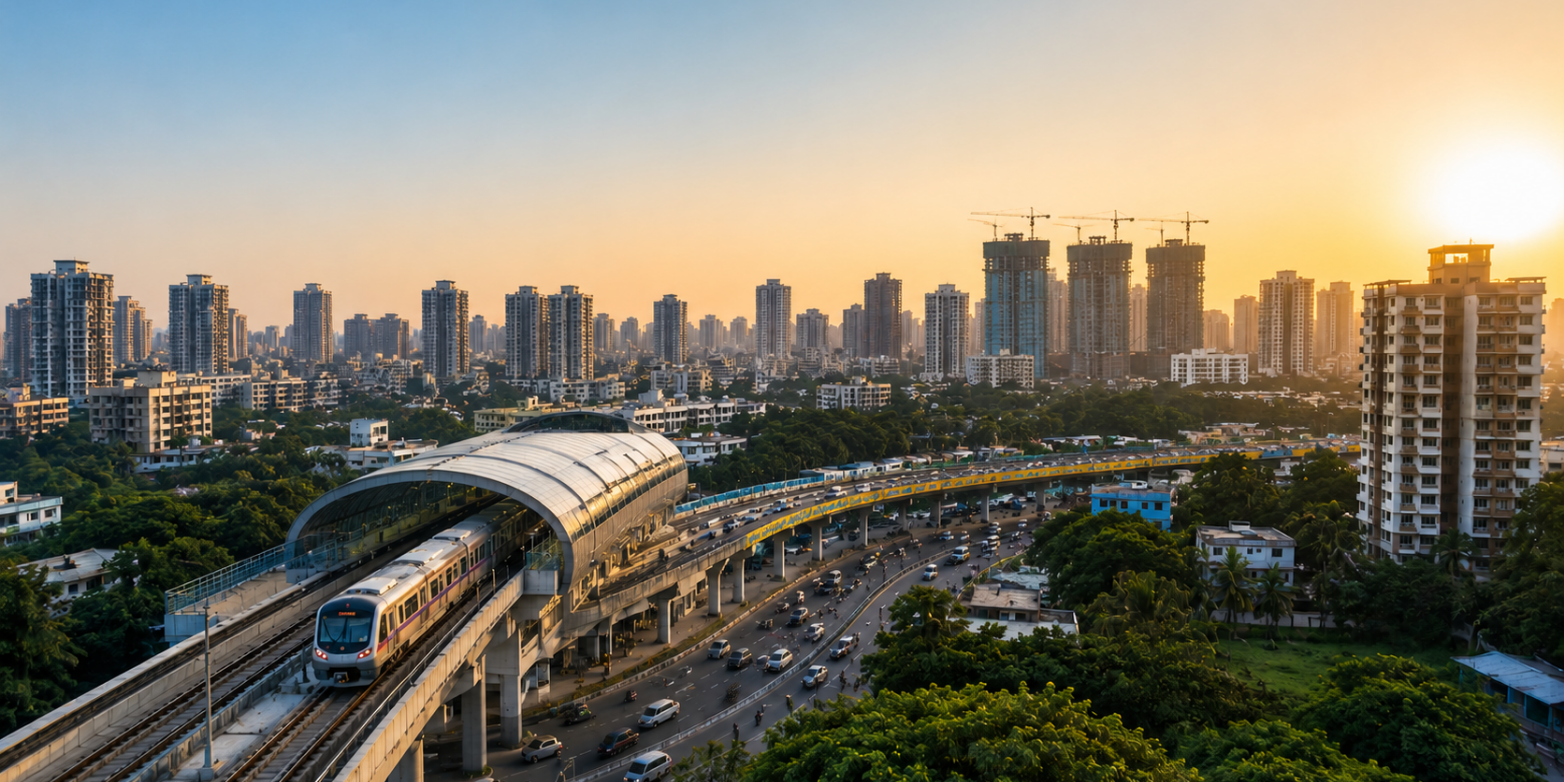
The western suburbs already combine housing demand, employment, metro and rail connectivity, retail, education and healthcare. Faster north-south movement could add another layer of value rather than creating a new market from scratch.
Arshad Lashkaria, CEO & Managing Director of Lashkaria Group, says Andheri, Jogeshwari, Goregaon and Borivali could benefit as faster access to South Mumbai strengthens already established residential and commercial markets.
Mumbai’s real estate equation has traditionally placed a premium on physical proximity to South Mumbai. But as transport infrastructure improves, the value of time may increasingly become just as important as distance.
For Arshad Lashkaria, CEO & Managing Director of Lashkaria Group, the Mumbai Coastal Road could accelerate that change by improving the relationship between the city’s core and its western suburbs.
The first phase of the Coastal Road has already established a faster connection between South Mumbai and the Bandra-Worli Sea Link. Its continuing expansion towards the northern suburbs, including the Versova-Dahisar corridor, is expected to further improve movement across Mumbai’s western belt.
The more significant benefit, according to Lashkaria, is not simply the number of kilometres reduced but the potential reduction in travel time.
A more direct western corridor can reduce dependence on the Western Express Highway and other heavily used arterial routes while making movement between South Mumbai, Worli, Bandra and the western suburbs more seamless.
That can influence residential preferences, business location decisions and investment patterns.
The implications are particularly relevant for Andheri, Jogeshwari, Goregaon and Borivali.
These locations have moved beyond being primarily residential suburbs and now contain substantial employment, commercial, retail and lifestyle infrastructure.
They also benefit from suburban railway connectivity, expanding metro networks, proximity to the airport and established social infrastructure.
Andheri is already one of Mumbai’s more connected western micro-markets, while Jogeshwari occupies a strategic position between Andheri, Goregaon and the eastern suburbs.
Goregaon has developed into a significant residential and commercial destination, while Borivali is benefiting from wider infrastructure improvements.
Better integration with the Coastal Road could allow these locations to operate increasingly as part of a connected western urban corridor rather than as individual suburban markets.
This also changes the investment proposition.
Real estate appreciation tends to be more sustainable when new infrastructure supports locations where demand, employment and social infrastructure already exist.
Unlike emerging locations that depend heavily on future development, Mumbai’s western suburbs already have established residential catchments, schools, healthcare, retail and employment centres.
Improved connectivity therefore adds another layer to an existing market rather than attempting to create demand from the beginning.
For investors, Lashkaria believes the opportunity lies in identifying markets where infrastructure can unlock another phase of value creation.
Improved accessibility can expand residential catchments, support rental demand, strengthen commercial viability and improve the longer-term attractiveness of existing neighbourhoods.
It also points towards a wider change in how Mumbai property markets may be evaluated.
Historically, proximity to South Mumbai itself commanded a significant premium.
As infrastructure compresses travel time, connectivity could increasingly influence value alongside physical distance.
Locations offering accessibility, liveability, amenities and relative value could therefore become more competitive even if they are geographically further from the traditional city centre.
From a developer’s perspective, infrastructure does not create real estate value independently.
Its strongest effect is often in locations that already possess sound fundamentals and where improved mobility amplifies existing residential and commercial demand.
The Coastal Road, together with Mumbai’s expanding metro and road network, could therefore support another phase of development across the western suburbs.
For Lashkaria, Mumbai’s next growth cycle will depend less on how far the city spreads and more on how efficiently established districts become connected.
If travel times between South Mumbai and the western suburbs continue to compress, the western corridor could increasingly function as one of the city’s major residential, commercial and investment markets rather than primarily as its suburban hinterland.
By Arshad Lashkaria, CEO & Managing Director, Lashkaria Group
At Prittle Prattle News, featuring you virtuously, we celebrate the commitment and innovation. Led by Editor-in-Chief Smruti Bhalerao, our platform is dedicated to sharing impactful stories that inspire change and create awareness. Follow us on LinkedIn, Instagram, and YouTube for more stories that matter.
About Prittle Prattle News
Prittle Prattle News is a digital news publication covering business, technology, healthcare, education, lifestyle, public affairs and other developments from India and around the world. Led by Editor-in-Chief Smruti Bhalerao, we publish timely news, industry updates and feature stories for a broad readership.




















Super satisfied – elegant gifts + promotion that delivers quality engagement
Feel free to surf to my web blog: bot telegram ai
Откровенные видео можно транслировать
на надежных платформах для обеспечения конфиденциальности.
Откройте для себя гарантированные источники видео для
качественного просмотра.
Feel free to surf to my web blog: ЖЕСТОКОЕ ПОРНО ФИЛЬМЫ
[…] Why Mumbai’s Coastal Road Could Shift Real Estate Value From Proximity to Connectivity, Explains A… […]