





In this opinion piece, Kamlesh Thakur, President of NAREDCO Maharashtra, argues that India’s rapidly growing cities must prioritise climate resilient infrastructure, water security and Sponge City planning to address increasingly frequent extreme weather events.
India’s cities are entering a new climate reality. The recent spell of intense rainfall across Mumbai and Maharashtra has once again highlighted how extreme weather events are becoming more frequent and more severe. Incidents once described as rare are now occurring with increasing regularity, raising important questions about the future of urban planning and infrastructure.
The challenge before cities is no longer limited to responding after disasters strike. The focus must shift towards designing urban environments that can withstand changing climate conditions while ensuring the long term safety and wellbeing of residents.
Climate resilience should become a central consideration for everyone involved in city development, including urban planners, policymakers, developers, engineers, environmental experts and civic authorities. The changing climate demands a fresh approach that moves beyond conventional planning models and prepares cities for future uncertainties.
One of the biggest contradictions facing many Indian cities is the coexistence of flooding and water scarcity. During the monsoon, heavy rainfall overwhelms roads and drainage systems, leading to widespread waterlogging. Yet only a few months later, many of the same cities struggle with declining water availability. As urban populations continue to grow, demand for water is increasing, making rainwater harvesting, groundwater recharge and water conservation essential components of future infrastructure planning.
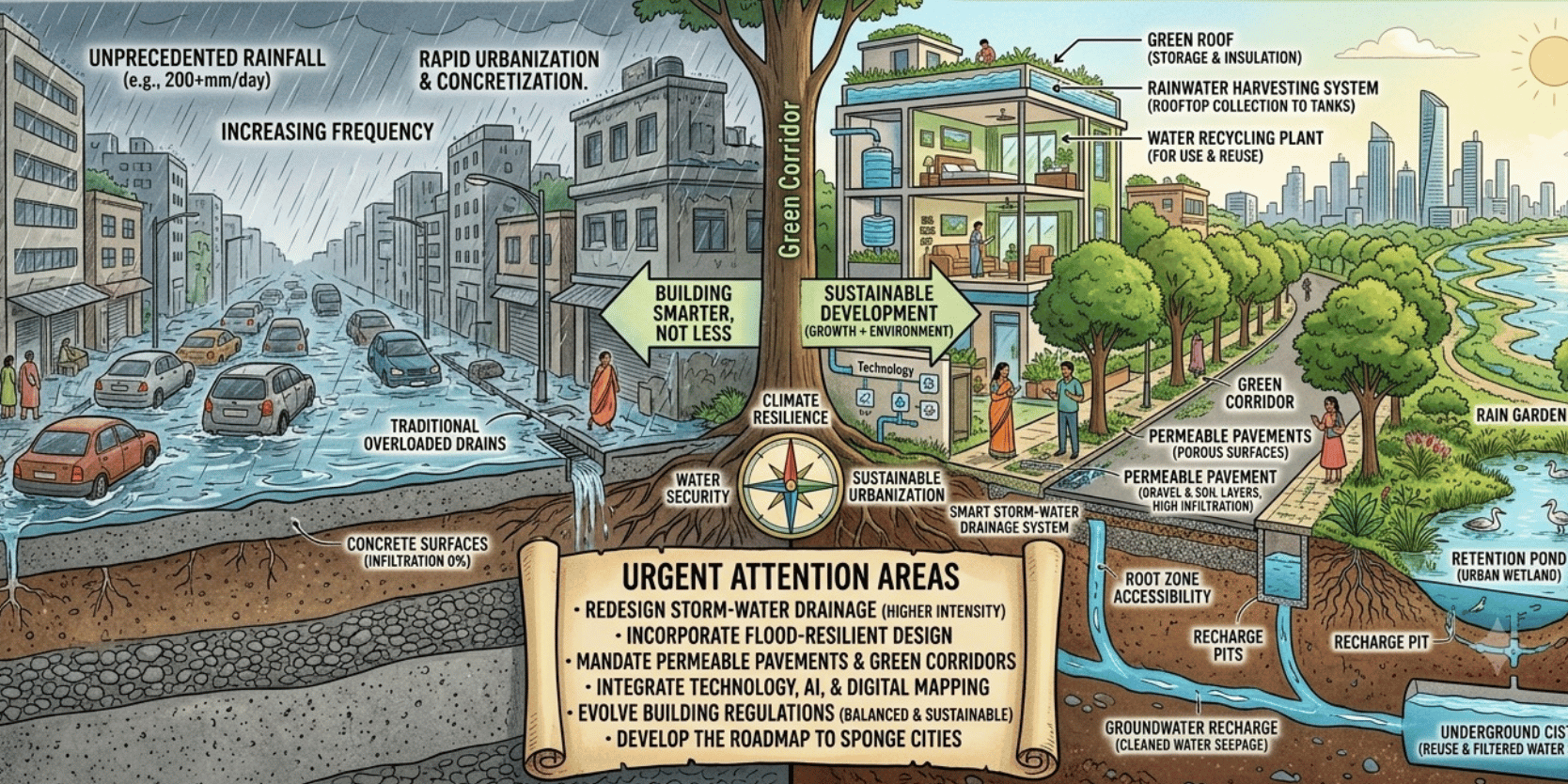
Rapid urbanisation has also transformed the physical landscape of cities. Expanding concrete surfaces have reduced the amount of open ground that naturally absorbs rainwater. Instead of percolating into the soil, rainwater is forced into drainage networks that are often unable to cope with extreme rainfall. This not only increases the risk of flooding but also limits groundwater replenishment, reducing long term water security.
Urban greenery faces similar pressures. Trees that have stood for decades are increasingly vulnerable during storms because excessive paving around their roots restricts natural growth and weakens their stability. Healthy urban forests require more than plantation drives. They require planning that protects root systems, preserves natural soil and allows trees to develop strong foundations capable of withstanding changing weather conditions.
One urban planning model that deserves serious attention is the concept of Sponge Cities. Widely discussed around the world, this approach encourages cities to absorb, store, filter and reuse rainwater rather than treating it as excess water that must be drained away immediately. Features such as permeable pavements, green roofs, wetlands, urban forests, rain gardens, recharge pits, lakes and modern storm water systems can collectively reduce flooding while improving groundwater recharge and strengthening water security. As climate risks continue to rise, this approach offers valuable lessons for Indian cities.
Several important questions now deserve immediate attention. Should storm water drainage systems be redesigned to account for higher rainfall intensity instead of relying on historical averages? Can every new development integrate rainwater harvesting, groundwater recharge, water recycling and flood resilient design from the planning stage? Should greater emphasis be placed on permeable surfaces, green corridors and open spaces to restore the natural urban water cycle? Can technologies such as artificial intelligence, digital mapping and real time weather forecasting become integral to urban planning and disaster management? Should building regulations evolve to create a better balance between development, environmental protection and long term resilience? Finally, is it time for Maharashtra to develop a comprehensive roadmap towards creating Sponge Cities that work in harmony with nature?
Construction activity is often blamed whenever flooding affects urban areas. While responsible construction practices remain important, the broader challenge lies in building resilient ecosystems where planning, governance, infrastructure and environmental management function together rather than in isolation.
The future of India’s cities depends not on reducing development but on improving the way development is planned and executed. Economic growth and environmental sustainability should be viewed as complementary goals that reinforce each other instead of competing priorities.
Climate resilience can no longer remain an afterthought in urban development. It must become a guiding principle for infrastructure planning. Mumbai has repeatedly demonstrated remarkable resilience in the face of adversity. Its infrastructure must now evolve to reflect that same resilience.
The conversation should therefore move beyond assigning responsibility after every extreme weather event and focus instead on collaborative, long term solutions. Governments, developers, engineers, urban planners, environmental experts and citizens all have an important role in building cities that are safer, greener, more water secure and better prepared for the challenges ahead.
The cities of tomorrow cannot be built using yesterday’s assumptions. Climate resilience, water security and sustainable urbanisation must become the foundation of India’s next phase of urban development.
At Prittle Prattle News, featuring you virtuously, we celebrate the commitment and innovation. Led by Editor-in-Chief Smruti Bhalerao, our platform is dedicated to sharing impactful stories that inspire change and create awareness. Follow us on LinkedIn, Instagram, and YouTube for more stories that matter.
About Prittle Prattle News
Prittle Prattle News is a digital news publication covering business, technology, healthcare, education, lifestyle, public affairs and other developments from India and around the world. Led by Editor-in-Chief Smruti Bhalerao, we publish timely news, industry updates and feature stories for a broad readership.



























[…] brings together culinary heritage and artisanal craftsmanship.Titled An Ode to Craft, this edition celebrates the people, places, traditions and creative practices that have shaped LOYA’s journey through […]