




Architect Narendra Sardeshpande of NSA Architects discusses how Indian homes can accommodate festive traditions through practical spatial planning. His approach focuses on natural light, functional entrances, integrated prayer areas, organised interiors and materials that complement contemporary architecture.
Architect Narendra Sardeshpande, Founder, NSA Architects, explains how natural lighting, ventilation, prayer spaces, uncluttered layouts and earthy materials can bring traditional Indian design principles into contemporary homes during Navratri and Diwali.
Festive Home Design: Combining Traditional Indian Spaces with Contemporary Architecture
By Architect Narendra Sardeshpande, Founder, NSA Architects
As Navratri and Diwali bring families and friends together, the home becomes an important setting for religious observances, gatherings and everyday celebrations. Preparing living spaces for these occasions offers an opportunity to reconsider how traditional Indian design principles can work within contemporary architecture.
Traditional residential planning has long considered sunlight, ventilation, orientation and movement within the home. These principles remain relevant today, particularly when applied through practical architectural decisions rather than rigid spatial prescriptions.
The objective is to create interiors that accommodate cultural practices while remaining comfortable, functional and visually coherent throughout the year.
Natural Light and Ventilation in Residential Planning
The orientation of living spaces can influence the amount of daylight entering a home, indoor comfort and the movement of fresh air.
Traditional Indian spatial planning often considered the direction of sunlight and prevailing winds when determining the placement of rooms and openings.
Contemporary passive architectural design applies similar considerations to reduce unnecessary dependence on artificial lighting and mechanical cooling.
Where site conditions permit, positioning living areas, courtyards or glazed openings towards the north and northeast can provide access to softer natural light.
However, the effectiveness of any orientation depends on local climate, surrounding buildings, window design and shading.
During Diwali, when lighting and hospitality become important elements of the home, well planned openings and connected living spaces can create an inviting environment for guests.
Integrating Prayer Spaces into Modern Interiors
Prayer areas have an important place in many Indian households, especially during festivals.
In smaller urban apartments, providing a separate room for prayer may not always be practical.
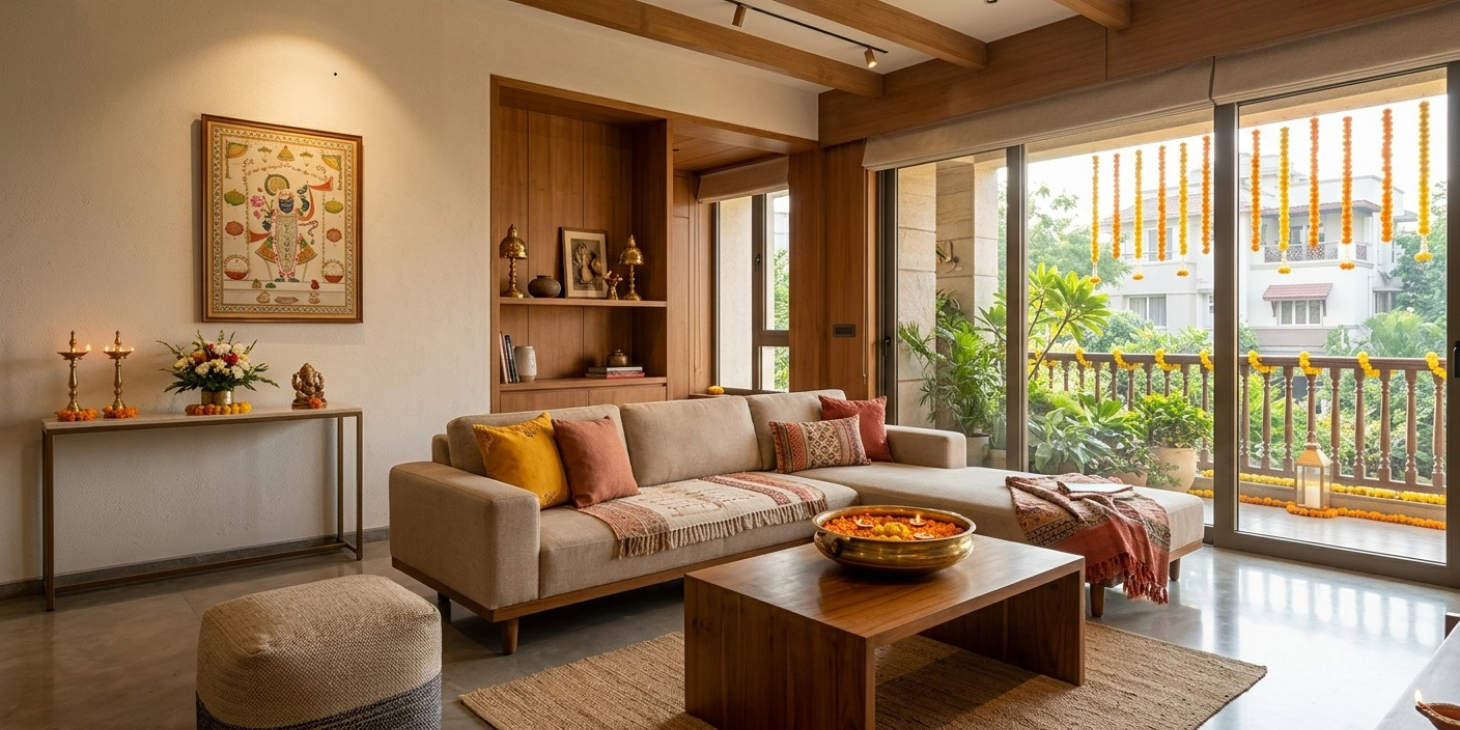
Instead, a dedicated pooja area can be incorporated into a living room or another suitable part of the home without interrupting the overall layout.
Wooden joinery, translucent stone panels and decorative jaali screens can provide visual separation while allowing light and sightlines to remain connected.
These elements can give the prayer area a distinct identity without requiring permanent walls or an enclosed room.
The entrance also deserves careful attention because it establishes the transition between the outside environment and the home’s interior.
A foyer with concealed storage, natural wood finishes and warm indirect lighting can provide an organised arrival space for visitors.
Keeping this area free of unnecessary furniture and household items can also make movement easier during festive gatherings.
Creating Open and Functional Living Spaces
The arrangement of furniture and storage plays a significant role in how comfortably people move through a home.
Festive preparations often involve cleaning, rearranging furniture and making space for visitors.
These activities can reveal opportunities to improve circulation and remove objects that obstruct movement.
Built in storage, flush cabinetry and furniture serving multiple purposes can help organise household belongings without occupying excessive floor space.
Maintaining clear walking routes and uninterrupted views between connected rooms can make compact interiors feel more open.
A less crowded setting also allows traditional festive decorations to receive greater visual attention.
Brass urlis, flowers and warm decorative lights can be arranged as selected focal points rather than distributed throughout an already crowded room.
The intention is not to remove personal or cultural objects, but to provide sufficient space for them to be appreciated.
Choosing Natural Materials and Neutral Colours
Materials influence both the appearance and tactile experience of residential interiors.
Natural stone, teak wood, terracotta and restrained metal detailing can connect contemporary spaces with materials traditionally used in Indian homes.
These finishes also offer opportunities to introduce texture without relying on elaborate decorative elements.
Neutral colours such as beige, warm grey, off white and muted wood tones provide a versatile background for changing seasonal decorations.
During Navratri and Diwali, brighter textiles, floral arrangements and festive lighting can be introduced without requiring permanent alterations to the interior.
After the festivities, the same materials and colour palette continue to support everyday residential use.
This approach allows seasonal decoration to remain flexible while preserving a consistent architectural character.
Designing Homes Around Everyday Living
A well planned home should accommodate both ordinary routines and occasions when more people gather.
The relationship between entrances, prayer areas, seating arrangements, storage and circulation becomes especially important during festivals.
Traditional spatial ideas can inform these decisions, but they need to be considered alongside practical requirements such as available floor area, ventilation, daylight and household preferences.
Contemporary architecture does not require cultural traditions to be abandoned. Instead, thoughtful design can incorporate familiar practices into layouts suited to present day living.
For homeowners preparing for Navratri and Diwali, the most useful improvements may involve better organisation, suitable lighting, accessible prayer spaces and careful furniture placement rather than extensive renovation.
Ultimately, residential architecture should respond to the people who use it.
By combining traditional knowledge of light, air and spatial relationships with contemporary planning methods, homes can remain welcoming during festivals and functional throughout the year.
At Prittle Prattle News, featuring you virtuously, we celebrate the commitment and innovation. Led by Editor-in-Chief Smruti Bhalerao, our platform is dedicated to sharing impactful stories that inspire change and create awareness. Follow us on LinkedIn, Instagram, and YouTube for more stories that matter.
About Prittle Prattle News
Prittle Prattle News is a digital news publication covering business, technology, healthcare, education, lifestyle, public affairs and other developments from India and around the world. Led by Editor-in-Chief Smruti Bhalerao, we publish timely news, industry updates and feature stories for a broad readership.



















Add Comment