




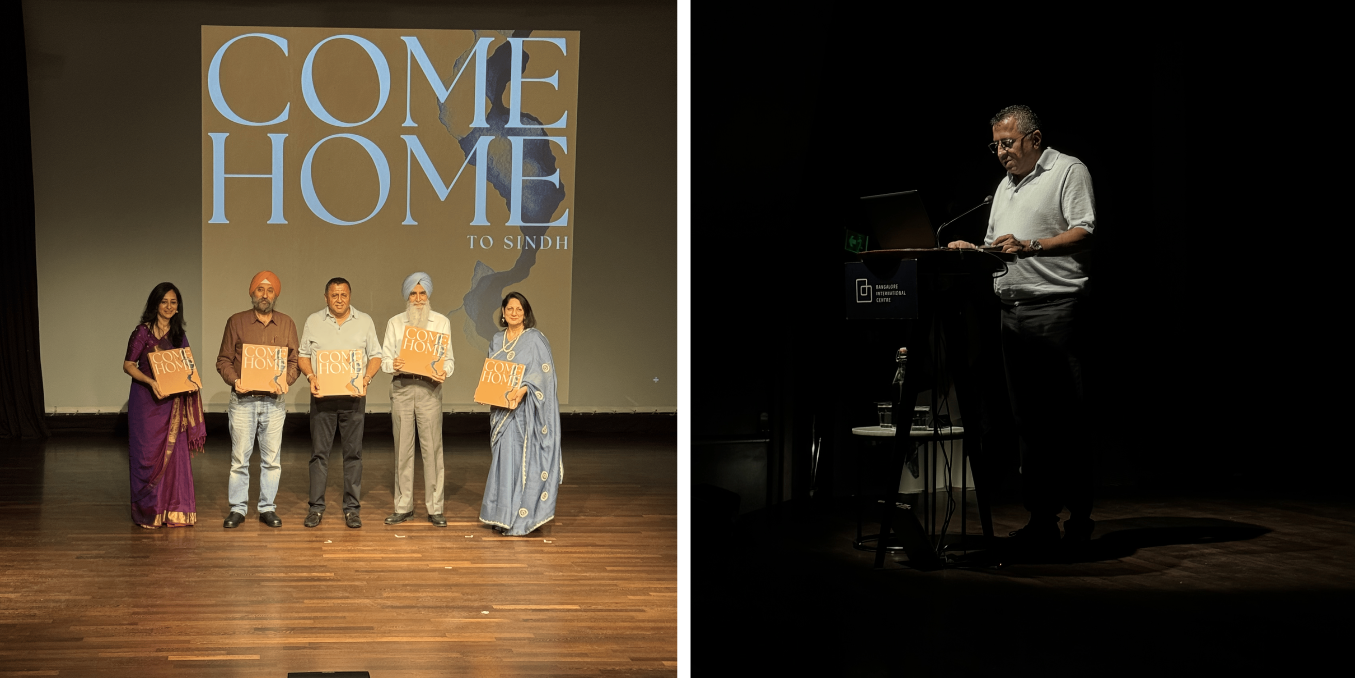
Photographs, essays, oral histories and memories of displacement come together in Come Home to Sindh, a coffee table book that takes the Sindhi Culture Foundation's work of preserving the community's cultural inheritance from the museum gallery to readers.
Aruna Madnani, Founder and Managing Trustee of Sindhi Culture Foundation, describes Sindh as a living memory carried through stories, songs, crafts and homes, as researcher and filmmaker Amardeep Singh joins the Bengaluru launch with a talk on Sindhi Nanak Panthis.
For a community separated from its ancestral homeland, memory can become a place in itself. Come Home to Sindh approaches that memory through photographs, essays, histories and cultural recollections that connect generations of Sindhis with a land many know through family stories rather than lived experience.
Sindhi Culture Foundation launched the coffee table book in Bengaluru as an extension of its work documenting and preserving Sindhi history and cultural identity.
The book draws inspiration from The Lost Homeland of Sindh, the Foundation’s permanent gallery at the Partition Museum in Delhi. Through photographs and essays, Come Home to Sindh revisits the history of a community displaced from its homeland while continuing to carry its cultural identity across generations.
The book was unveiled by Jitu Virwani, Chairman, Embassy Group. The Embassy Group has supported the creation of The Lost Homeland of Sindh gallery at the Partition Museum.
The Bengaluru launch was accompanied by From Indus to Exile: An Exploration of Sindhi Nanak Panthis, a talk by Singapore based researcher, author, photographer and documentary filmmaker Amardeep Singh. The programme was held in association with the Bangalore International Centre.
Together, the book and the accompanying discussion placed the idea of Sindh within a wider conversation about memory, displacement, spirituality and cultural continuity.
At the centre of Sindhi Culture Foundation’s work is an effort to document what survives when a community is separated geographically from its place of origin.
Its permanent gallery, The Lost Homeland of Sindh, is located within the Partition Museum at the Dara Shukoh Library in New Delhi. The exhibition traces the displacement of Sindhis through historical artefacts, fragments of havelis and oral histories.
Rather than limiting that history to the moment of Partition, the gallery also records how displaced families rebuilt their lives while preserving connections with their ancestral culture.
Come Home to Sindh takes that work into another format.
Aruna Madnani, Founder and Managing Trustee of Sindhi Culture Foundation, said, “Sindh is more than a place on a map, it is a living memory carried in our stories, songs, crafts and the warmth of our homes.”
“With this book, we invite readers to walk through the streets of a homeland many have never seen, yet deeply feel. Come Home to Sindh is our way of saying, your roots are here, your history matters and your culture continues to thrive,” Madnani added.
That idea gives the book particular relevance for younger generations whose relationship with Sindh may have been formed through language, food, music, family memories and inherited traditions rather than direct experience of the region.
Sindhi Culture Foundation has been working across several formats to preserve these connections.
Doorway to Sindh, its online lecture and video series, explores Sindhi history, language, art and culture. Sindh Partition Stories records oral histories and voices from the community, creating an archive of personal experiences that might otherwise disappear with time.
The Foundation has also organised programmes around Sindhi folk and Sufi music, handicrafts, embroidery and conversations with writers and scholars. Encouraging younger generations to use the Sindhi language forms another part of its cultural work.
The Bengaluru programme widened this conversation through Amardeep Singh’s exploration of Sindhi Nanak Panthis.
In his talk, Singh examined the spiritual and cultural traditions of Sindhi Nanak Panthis and their reverence for Guru Nanak within the pluralistic cultural environment of the Indus region.
Drawing upon field research and visual documentation, he traced the tradition through religious reform movements, colonial classifications, Partition and displacement. The discussion considered what its continued evolution reveals about identity, belonging and cultural continuity.
Singh’s wider work has focused on documenting cultural histories at risk of being lost. He is the author of the two volume Lost Heritage: The Sikh Legacy in Pakistan and creator of the documentary series ALLEGORY: A Tapestry of Guru Nanak’s Travels.
He also leads Oneness in Diversity, a multilingual audiovisual archive examining the musicology and philosophy of Guru Nanak and fifteen Indic saints.
The launch programme brought together community members, cultural enthusiasts and audiences interested in Sindhi history and heritage. It included Singh’s talk, a discussion and an audience question and answer session, following an informal Taste of Sindh gathering.
For Sindhi Culture Foundation, Come Home to Sindh adds a physical and accessible record to a larger preservation effort that already spans museum exhibitions, oral histories, lectures and cultural programmes.
Its significance ultimately lies in what it attempts to retain.
A homeland can be separated from a community by history and geography, but language, photographs, songs, objects, personal accounts and family memories can continue travelling from one generation to another.
Come Home to Sindh gives some of those memories another place to live.
At Prittle Prattle News, featuring you virtuously, we celebrate the commitment and innovation. Led by Editor-in-Chief Smruti Bhalerao, our platform is dedicated to sharing impactful stories that inspire change and create awareness. Follow us on LinkedIn, Instagram, and YouTube for more stories that matter.
About Prittle Prattle News
Prittle Prattle News is a digital news publication covering business, technology, healthcare, education, lifestyle, public affairs and other developments from India and around the world. Led by Editor-in-Chief Smruti Bhalerao, we publish timely news, industry updates and feature stories for a broad readership.



















В интернете можно найти тысячи отечественных фильмов,
и все их доступны без оплаты.
сериалы онлайн на русском языке
[…] Luxury Escapes In and Around Delhi for the Independence Day Weekend Luxury Escapes around Delhi take on a different character during the Independence Day weekend. A few extra days away from […]
Super easy to get started and the interface is very user friendly. I managed to hit a jackpot on my second try. I’m staying with jili56comlogin for sure.